
How Does an InBody Scan Work? Electrodes, Current, Math
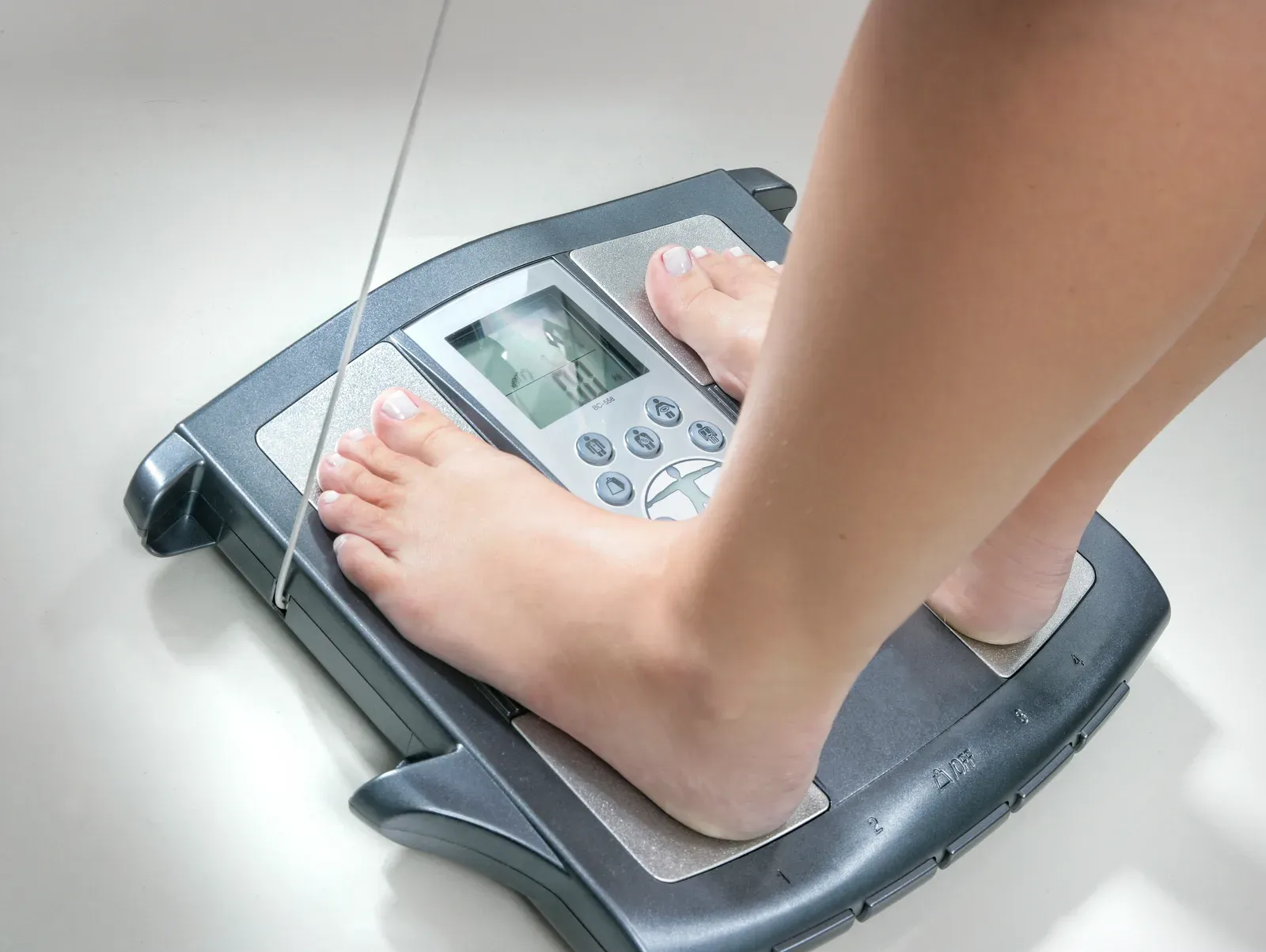
An InBody scan works by sending a very small alternating current through eight electrodes, one set under your feet and one in your hands, measuring how much each arm, leg and your trunk resists it, and then using equations to turn those resistance values into estimates of water, muscle and fat. The technique is called bioelectrical impedance analysis. It is quick, painless and repeatable, which is why it suits tracking a training program. The free scan that comes with a free consultation at FlexWerk in Carmel is the simplest way to see it in action.
Step one: the eight points of contact
You stand on the machine barefoot, with the ball and heel of each foot on separate metal plates, and you hold two handles so that your thumb and fingers rest on separate electrodes. That makes eight contact points, and the layout is deliberate. Current can enter at one hand, travel through the body, and exit at a foot, so the machine can measure each limb and the trunk as separate segments instead of treating you as one cylinder.
Measuring in segments is why the sheet can show your left arm against your right arm, and why a dedicated page on lower leg lean values is even possible. Older, simpler devices send a single path and only produce a whole-body figure.
Step two: why several frequencies matter
The scan does not use a single signal. It runs a sequence of frequencies, and the choice is the clever part:
- Lower frequencies struggle to get through cell membranes, so they travel mostly in the fluid outside your cells.
- Higher frequencies pass through membranes and travel inside cells as well.
By comparing the resistance at each, the device can estimate how much water sits outside cells, how much inside, and so how much in total. That is the origin of the extracellular water measure and the ratio you may have seen on a printout; the page on ECW ratio shows what the ratio does and does not mean.
Step three: from resistance to mass
Here is the sequence the software runs, in plain terms:
- It reads the resistance for each of the five segments.
- It estimates the volume of water along each segment from the resistance and from your height, since a taller limb conducts differently from a shorter one.
- It converts water to lean mass, assuming that lean tissue holds a fairly steady share of water.
- It subtracts lean mass from your scale weight, and what remains is fat.
- It splits lean mass into muscle and the rest using adjustments for age, sex and build.
Every one of those steps is built on equations validated against reference measurements such as DEXA and other clinical methods. Those equations are good on average. They are not a direct view of your tissue, which is why the number is called an estimate. The comparison of the two methods is in InBody versus DEXA.
A toy example of the arithmetic
Numbers make the chain concrete, so here is a simplified, invented case. Suppose the software decides that a 170 pound person holds 90 pounds of water, and that lean tissue is about three quarters water. Dividing 90 by 0.75 gives about 120 pounds of lean mass. Subtract 120 from 170 and the fat estimate is 50 pounds, which is just under 30 percent of body weight.
Now imagine the same person arrives dry, and the machine sees 85 pounds of water instead. Lean mass becomes roughly 113 pounds and fat jumps to about 57 pounds, over 33 percent, with no fat gained. That is the whole mechanism behind surprising scans, and it is why the pages on dropped scores and dehydrated scans start with hydration. The real equations are more refined and use segment by segment values, but the logic of water first, lean second, fat last is the same.
Three common misunderstandings
- “It weighs my fat.” It does not. It never touches fat directly and only infers it.
- “Higher frequency means a stronger shock.” The signal stays tiny at every frequency; the difference is where the current can travel, not how hard it is.
- “A bigger machine is more accurate.” Reliability comes from consistency of use and preparation, rather than size, so a single well-run machine beats switching between several.
What it cannot see
The method assumes your water share is typical. When it is not, the estimates drift:
- Dehydration or a recent big drink. Water is the raw measurement, so both bend the answer.
- A workout beforehand. Fluid shifts into working muscle and sweat leaves the body.
- Heavy meals. The stomach and gut add weight and change the signal.
- Unusual body types or health conditions. Very muscular people, people with swelling and those with some medical conditions fall outside the average the equations expect.
Nothing here makes the scan useless. It means the number you want is the one measured under matched conditions, every time, rather than the one measured on a rushed afternoon.
How coaches use that knowledge
A coach does not treat the printout as truth about one day. They use it as a repeatable instrument. That means choosing the same hour for each scan, asking you to follow the same routine, and watching direction across several scans instead of reacting to a single one. The quality of the trend then depends on your preparation, not on how clever the machine is. Our preparation checklist lays out what to do.
Safety and who should skip it
The current is far below anything you can feel, and there is no radiation. People with implanted electronic devices such as pacemakers, and people who are pregnant, are commonly advised to skip the scan or ask a clinician first; the safety page covers those exceptions in detail.
Reading the result once you have it
The scan itself takes about a minute, but it is the first step of a longer process. If you want to understand the printout line by line, the pillar guide to every InBody number is the place to go, and you can compare it with the two other tools coaches use, a tape measure and progress photos, in photos versus body scans.
The short version for your next scan
Remember three facts: the machine measures water first, it estimates muscle and fat from it, and it is most useful when you control the conditions. Book the free scan, keep your routine tidy, and ask the coach to talk you through each segment. Then rescan four to six weeks later, in the same way, and let the pattern do the talking.
Related questions
Can you feel the current during an InBody scan?
Almost never. The signal is far too small to sense, so most people notice only the cool grips and footplates and the instruction to hold still for about a minute.
Why does the machine ask for my height, age and sex?
Because the equations that turn resistance into mass are built for body size and typical differences between groups. Entering them accurately matters, since a wrong height or age shifts every estimate.
Is the answer the same on every InBody machine?
Close, but not identical. Different models and software versions use slightly different equations, which is why you should always scan on the same machine when you want to compare results over time.