
Does Strength Training Improve Your Pickleball Game?
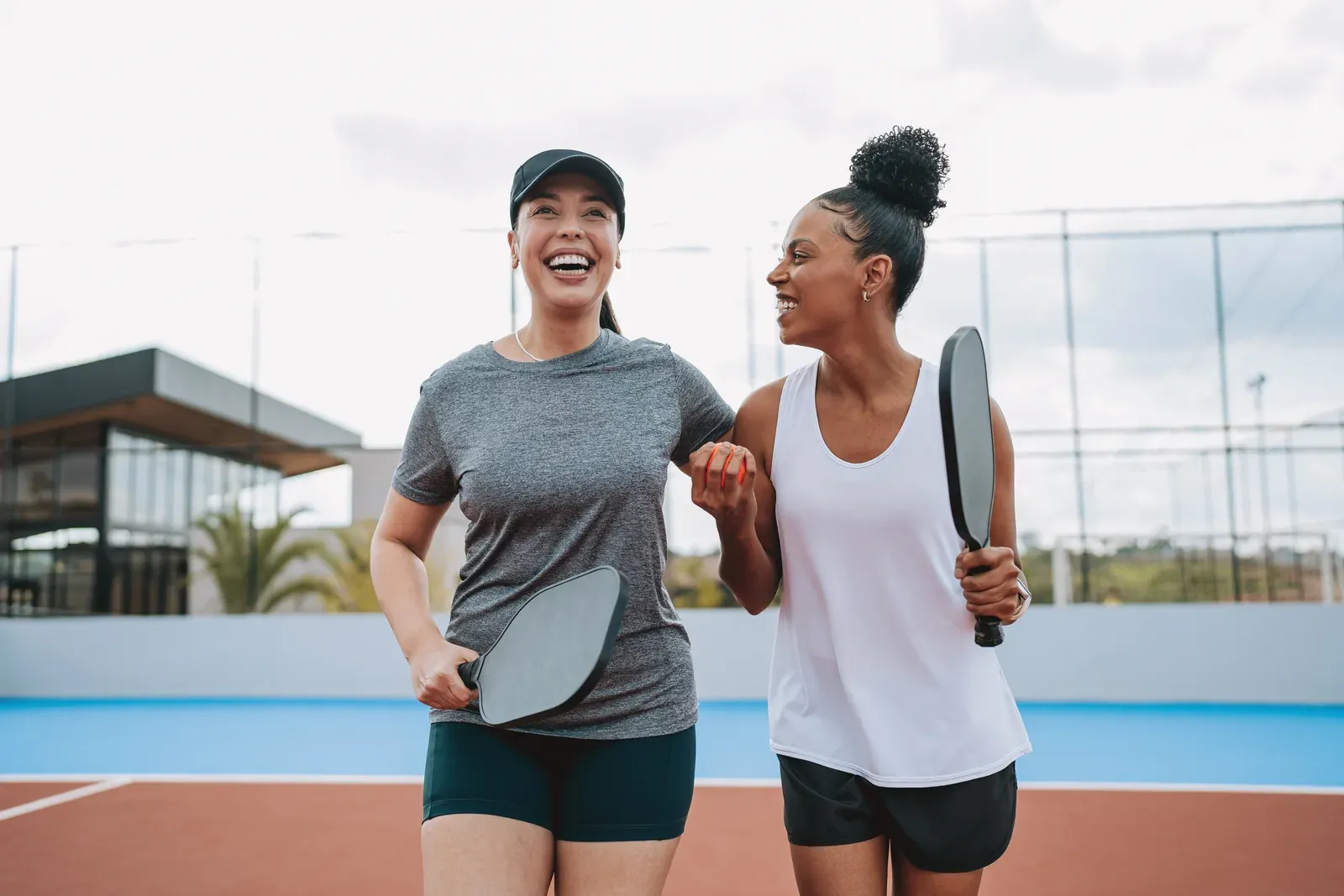
Yes. Strength training improves your pickleball game in four measurable ways: a faster first step to the ball, more pace on drives and serves, legs that hold their squat depth deep into long rally days, and better balance in the scrambles that decide close games. Pickleball looks gentle from the fence, but points are won by whoever moves first and lasts longest, and both of those are gym qualities wearing court shoes.
Central Indiana’s pickleball boom makes the question practical: with 24/7 DINK opening in Fishers in February 2025 with 20 indoor courts, the largest facility in central Indiana, plus Pickle on Penn, Meadowlark Park, and the Monon Community Center, locals can now play as much as their bodies allow. If you want your body to allow more, a free consultation with a coach, free InBody baseline included, is the direct route.
What actually wins rallies
Watch good recreational pickleball closely and the pattern is consistent: the player who reaches the ball in balance controls the point. That decomposes into trainable qualities. The first step is lateral power, produced by hips and legs. Drive and serve pace is rotational power, the trunk delivering force the way a golf swing or tennis stroke does. Kitchen-line play is a partial squat held for minutes at a time, which is isometric leg endurance by another name. And the lunging, reaching, direction-changing chaos of a scramble is strength expressed through balance.
None of these improve much from playing alone, because games rehearse the qualities you already have. Improving the qualities themselves is the weight room’s job.
Doubles adds one more quality worth naming: repeated get-up-and-go. Points end, you reset, you explode again, dozens of times an hour, and the ability to repeat short bursts without fading is trainable conditioning, not talent.
The four things to build
A pickleball strength program is short and specific:
- Leg strength and endurance. Squats, split squats, and step-ups build the base; wall sits and tempo work build the kitchen-line stamina that keeps your dinks crisp in game three.
- Lateral power. Lateral lunges, skater bounds, and low, quick shuffle work convert leg strength into that first explosive step toward the sideline.
- Rotational power. Cable chops and rotational throws put weight behind your drives; the pattern transfers across every rotation sport, which is why it shows up in adding driving distance after 50 too.
- Balance and single-leg control. Single-leg strength work trains you to decelerate and recover in balance, and doubles as a longevity investment; the same abilities show up in the balance tests physicians use as markers of aging well.
Shoulder and grip work rounds out the list in small doses, keeping the paddle arm durable across a heavy playing schedule.
A simple two-day week
Two one-hour sessions cover everything without touching your court calendar. Day one leans strength: squats or split squats, a hinge, upper-body pushing and pulling, calf raises, trunk work. Day two leans power and movement: lateral and rotational power drills, lighter loads moved fast, single-leg and balance work, and short conditioning finishers if endurance is your gap. Loads progress a little most weeks, and the program flexes around tournament weekends. Most players schedule the sessions on non-playing days, though back-to-back with a light session works fine once you are adapted.
If you can only manage one session a week, take it; one full-body hour with a coach maintains far more than zero, and busy seasons are when the habit matters most. And if you play four or more days a week, the program earns its keep twice over, because that schedule is exactly the kind of repetitive load an untrained body eventually complains about.
At FlexWerk, those sessions run one on one with a coach in a private suite at Carmel City Center, which suits this sport’s demographic well: many pickleball players are new or returning to lifting, and learning skater bounds and cable chops with a coach’s full attention, rather than an audience, is both faster and safer. Sessions book by the hour around work schedules, with weekday doors open from 5 AM.
The honest fine print
Strength work improves performance; it does not make you injury-proof, and the two goals deserve separate attention. Players over 50 in particular should read the risk side of the sport, including why 91% of pickleball injuries occur in that age group, in pickleball injury prevention for players over 50; happily, the training that lowers risk and the training that wins rallies overlap heavily. If you have joint, bone, or heart conditions, check with your physician before ramping up either the training or the playing schedule, and let your coach build inside that guidance.
Expect the timeline to be encouraging but not magical: quicker feet and steadier legs commonly show up within a month, power over two to three months, and the compounding benefits across a season. No coach can promise you a tournament finish; what a program reliably delivers is a version of you that gets to more balls with more in the tank.
Age is not a limiter here either; the sport’s own demographics are the proof. Players starting strength training in their 50s, 60s, and beyond adapt reliably, and the gym is considerably more forgiving than the court about how you begin.
The courts around here are full, the winters are no excuse anymore, and the fastest upgrade available is not a new paddle. Book the free consultation and give your game the two hours a week it has been asking for.
Related questions
How quickly will gym work show up on the pickleball court?
Commonly, players notice quicker movement and steadier legs within about a month, with power gains building over two to three months. The nervous system adapts before the muscle does, which is why early sessions pay off fast.
Will lifting make me slow or bulky for pickleball?
No. Two sessions a week of strength and power work makes recreational athletes faster, not slower, and meaningful bulk requires far more volume and eating than this kind of program involves.
Do I need to stop playing while I build strength?
No. Keep playing; the program is designed around your court schedule. Most players simply add two off-court hours a week and let the games themselves sharpen the new qualities.