
Golf Fitness for Fishers Golfers: Speed That Lasts All Season
For Fishers golfers, the gap between May optimism and August reality is physical: rotation speed you never built, and a lower back that was never prepared for a full season of league nights, weekend rounds, and scrambles. Both are trainable, one on one, 15 to 20 minutes from Fishers at Carmel City Center, and the Fishers personal training page covers the full logistics of the drive. This page covers what a golf-specific program actually does for your season.
League season is a workload spike
Count the rotations. A weekly league night, a weekend round, range sessions, and the summer’s outings add up to thousands of near-maximal rotational efforts between April and September, delivered by a body that mostly sat at a desk from October through March. That is the textbook definition of a workload spike, and it explains the standard Fishers golf season arc: fresh through May, tight through July, managing a cranky back by August, distance quietly fading the whole way.
Training does not make you injury-proof, nothing does, and a back that already hurts belongs with your physician or a physical therapist before it belongs in a program. What structured strength work does is raise the capacity underneath the season: hips and trunk strong enough that a 36-hole weekend is a workload your body has met before, not a surprise it pays for on Monday.
Rotation speed: the trainable distance
Clubhead speed comes from force, range of motion, and sequencing, and for most amateurs past 35 the first two are the limiting factors, which is good news, because those are the two the gym can change. Lower-body strength builds the ground force the swing starts from; hip and upper-back mobility restore the turn that desk years quietly confiscated; rotational power work, cable chops and explosive throws, teaches the trunk to deliver force at swing speed. The full breakdown of those qualities lives in the Carmel golf fitness guide, and the distance-specific version, including why speed responds at any age, is covered in how to add driving distance after 50.
What matters for a Fishers golfer deciding whether to bother: the strength-and-mobility gap between playing partners is usually worth more yards than any equipment change, and it compounds season over season instead of depreciating.
Speed work also pairs with lessons instead of competing with them. Your teaching pro sharpens sequencing and mechanics; the gym raises the ceiling those mechanics operate under. Golfers who do both tend to stop having the annual argument about whether the problem is the swing or the body, because each side of it is finally being addressed by the right professional.
Durability work that pays in September
The unglamorous half of golf fitness is the half that keeps you playing:
- Hinge patterns that teach your hips, not your lumbar spine, to bend and load.
- Anti-rotation trunk work that lets you resist force as well as produce it, which is what posture over the ball actually is.
- Lead-hip strength and mobility, the side that absorbs the swing’s braking forces round after round.
- Upper-back mobility, so the turn comes from segments built to rotate instead of ones that complain when forced to.
Two coached hours a week covers all of it, programmed so the heavy work never lands the day before league night. Scheduling around golf is the quiet advantage of appointment-based training: a Monday-Thursday lift pattern keeps legs fresh for a Wednesday league and a Saturday round, and when an outing lands on a training day, the session moves instead of vanishing. Nobody’s program should die because member-guest week arrived.
The golf calendar, programmed
Indiana hands golfers a long off-season, and smart training treats it as the gift it is. In-season, the program maintains: speed touched weekly, loads managed, mobility protected, fatigue watched. When the clubs go away, the building starts, and winter is where next year’s distance actually comes from; the Indiana off-season golf plan maps that window month by month. Winter sim leagues make an honest scoreboard for it: watch ball speed trend up across twelve weeks of training and the argument settles itself. A Fishers golfer who starts in October arrives at the spring opener with a different body than the one that limped through August, and that is the whole point of living somewhere the season ends.
From Fishers to the first tee
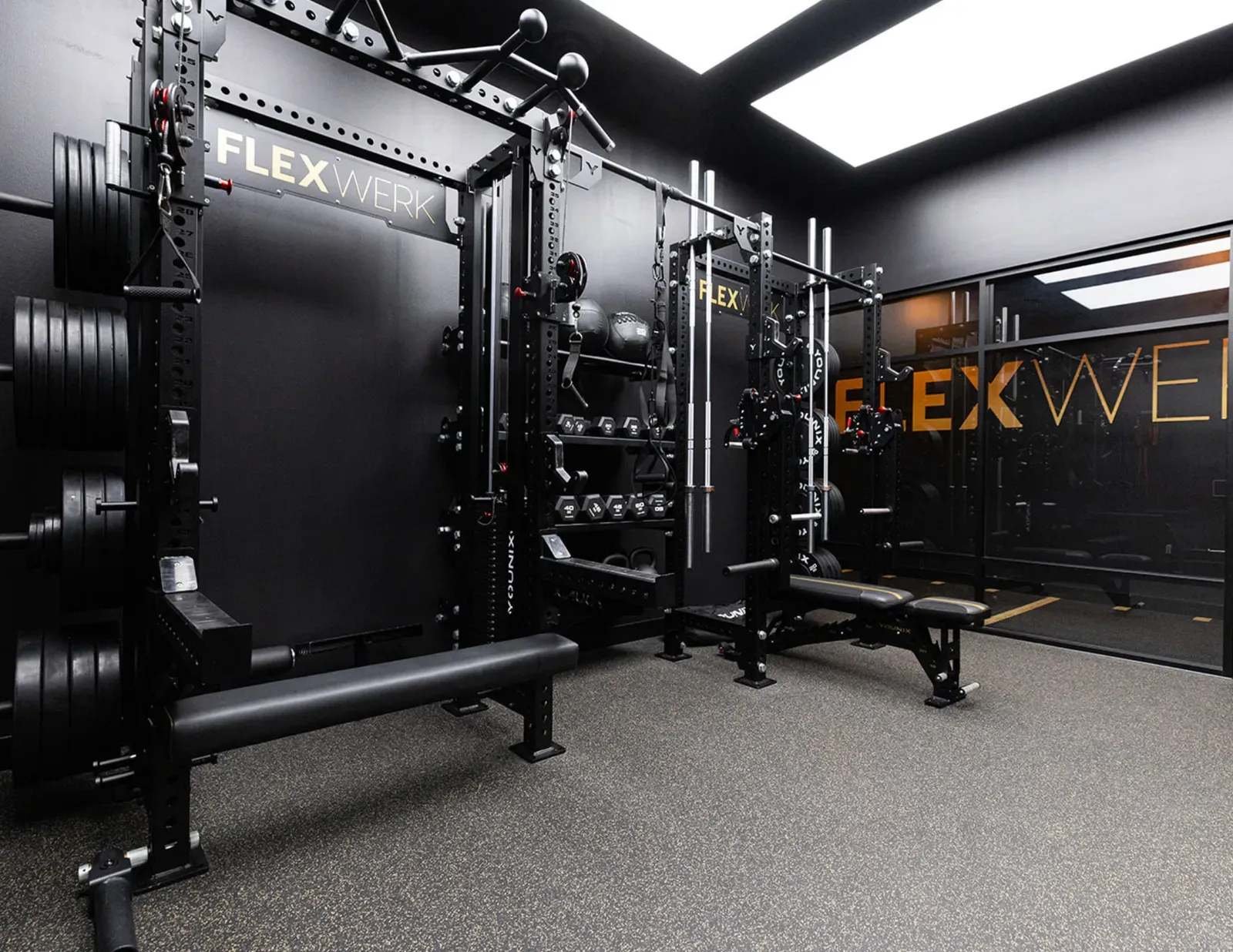
The practical picture: FlexWerk sits at 885 Monon Green Blvd in Carmel City Center, 15 to 20 minutes from most of Fishers via 116th Street or 146th Street, with garage parking a short walk from the door. Every session runs one on one in a private FlexSpace reserved for your hour, a custom lifting rack, cable system, and dumbbells, which matters more for golfers than most: rotational training looks awkward before it looks athletic, and a private room with no audience is where golfers actually stick with it. The suites are filming-friendly with a monitor in the room, so a coach can film a medicine-ball throw or a chop pattern and correct it on the spot. Hours run 5 AM to 9 PM weekdays and 7 AM to 4 PM weekends, so training fits before work or around tee times. It starts with a free consultation, including a free InBody body composition scan and a conversation about your game, your schedule, and whatever your back has been telling you.
If this season exposed the gap, the fix is two hours a week and a short drive down 116th; next season does not have to end the same way.
Related questions
Will golf fitness training change my swing mechanics?
Not directly, and it should not try; mechanics belong to your teaching pro. Training changes what your body can deliver through those mechanics: more force, more usable turn, and a trunk that holds its posture deep into a round.
How many sessions a week does a golfer need?
Two one-hour sessions is the standard build rhythm, dropping to one in the heart of league season. That leaves plenty of week for range time and rounds, which is the point.
Can I start golf training mid-season?
Yes, with sensible loading. Mid-season work leans toward mobility, trunk control, and maintaining speed rather than chasing new strength peaks, then the real building starts when the clubs go away in fall.