
What Does Hockey Strength Training in Carmel Cover?
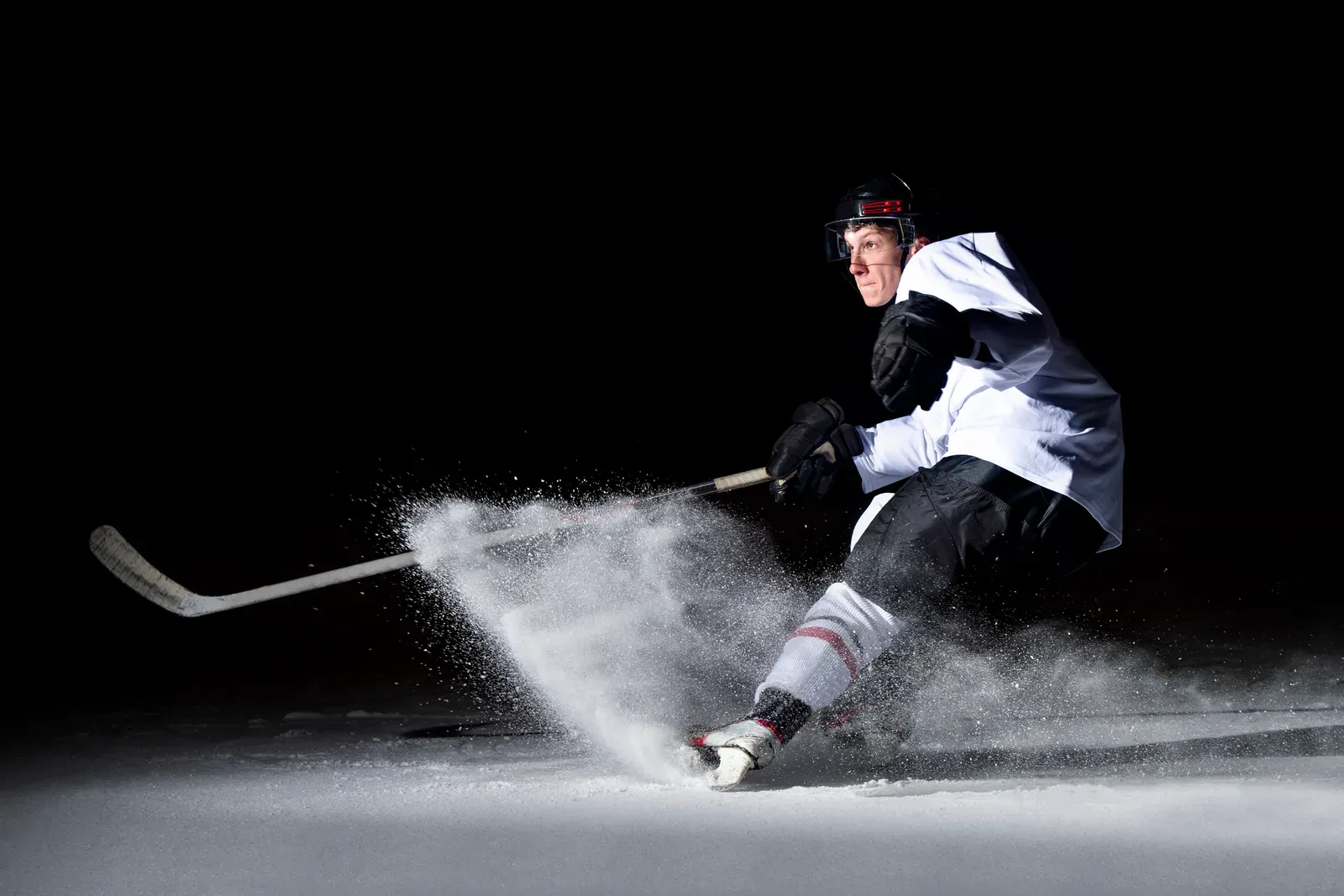
Hockey strength training lives off the ice, and it has three priorities: single-leg strength for a sport that is one long series of one-leg pushes, hip and groin durability for the deep skating position that stresses them, and explosive power for the first three strides that decide most races to the puck. Ice is for skill. The qualities underneath the skill are built in a training room, which is convenient in central Indiana, where ice time is scarce and the training room is always open.
The starting point at FlexWerk is a free consultation with a free InBody body composition scan, a baseline worth having for a sport that hides its athletes under equipment.
Skating is a strength quality
A hockey stride is a maximal one-leg hip extension from a deep knee bend, repeated hundreds of times a game. That maps to a clear gym menu: squat and hinge strength as the base, heavy single-leg work, split squats, step-ups, single-leg hinges, as the sport-specific layer, and lateral power, skater bounds and lateral pushes, as the conversion. Trunk strength ties it together, because shooting, checking, and protecting the puck are all rotation-under-pressure events. Players feel this work exactly where they hoped: a deeper, longer stride and a harder first three steps.
The hip and groin deserve special attention
Hockey’s signature soft-tissue trouble concentrates in the adductors, groin, and hip flexors, the structures the skating position loads relentlessly. Durable hips are trainable: dedicated adductor strengthening, controlled range work, and balanced hip loading are standard in serious hockey preparation, and they are precisely the details a coach watching one athlete catches and a crowded team session misses. The medical line stays bright here: an existing groin, hip, or back issue goes to a physician or physical therapist first, and coached training then runs alongside the clinical plan, the division of labor described in training around an injury.
Youth players, adult leagues, same building
For youth players, the standard rules of adolescent training apply: supervision on every rep, technique before load, progression earned, no maxing for growing athletes, all consistent with pediatric sports medicine guidance and all natural in a one-on-one setting where a parent is welcome to stay. The building windows follow the season: summer is the big block, worth planning with our summer training guide for high school athletes, and in-season work drops to short maintenance sessions on the logic laid out in in-season versus offseason training.
Adult league players may be the quiet majority of Carmel hockey, and the same program scaled to a working adult pays off fast, especially with a schedule that accommodates hockey’s strange hours: FlexWerk runs 5 AM to 9 PM weekdays and 7 AM to 4 PM weekends, with sessions in a reserved private suite, lifting rack, cable system, dumbbells, and no waiting, at 885 Monon Green Blvd in Carmel City Center, garage parking a short walk away. FlexConnect matches you or your player with one of the more than 40 independent professionals based here; ask for athletic performance experience and say the word hockey.
If your stride has a ceiling the ice cannot fix, book the free consultation and let a coach raise it from the floor up.
Related questions
Why is off-ice training so important in hockey?
Ice time is scarce and expensive, so it should be spent on skill. Skating speed and shot power are built from strength and power qualities that develop faster and more safely in a training room than in drills.
What is the biggest off-ice priority for young players?
Single-leg strength and hip durability. Skating is a series of one-leg pushes from a deep hip position, and the adductor and groin structures that position stresses respond well to dedicated strength work.
Do adult league players benefit from the same training?
Yes, often more visibly. Adults who play weekly on untrained legs feel the difference within weeks of consistent strength work: deeper stride, steadier balance, and recoveries that take a day instead of three.