Audiences
Never Trained Before? What Beginner Coaching Actually Looks Like

Here’s what nobody tells you about hiring a trainer as a total beginner: you are the easiest, most normal client a coach ever takes on — beginner coaching is a patient teaching process that starts from zero, assumes nothing, and at FlexWerk happens inside a private suite where no one watches you learn. The industry’s imagery (sweat, screaming, transformation montages) describes almost nothing about what your first month will actually contain. Let’s replace the imagery with the reality.
What the first session actually contains
Less sweat than you think, more conversation than you expect. A genuine first personal-training session is mostly assessment and teaching:
- Talking. Your goals, schedule, injury history, and what you honestly will and won’t do. A coach programs around your real life, not an idealized one.
- Moving, gently. Basic patterns — squatting to a box, hinging at the hips, pushing, pulling, carrying — at loads chosen to reveal how you move, not to test your limits. Think tutorial level, deliberately.
- A baseline. At FlexWerk, everything starts with a free consultation that includes an InBody body-composition scan — an objective picture of muscle and body fat, so that in eight weeks “is this working?” has a measured answer instead of a mirror-based guess.
What it doesn’t contain: a fitness test you can fail, a vomit-inducing “welcome workout,” or judgment about how you got here. A coach whose first session flattens you is showing off, not coaching — it’s fine to treat that as a red flag.
The beginner’s real enemy isn’t fitness — it’s the room
Ask people why they never started, and the honest answer is rarely “couldn’t find a workout plan.” The internet has millions. It’s the gym itself: not knowing how anything works, feeling watched while figuring it out, the sense that everyone else got a manual you didn’t. That feeling has killed more fitness journeys than any injury.
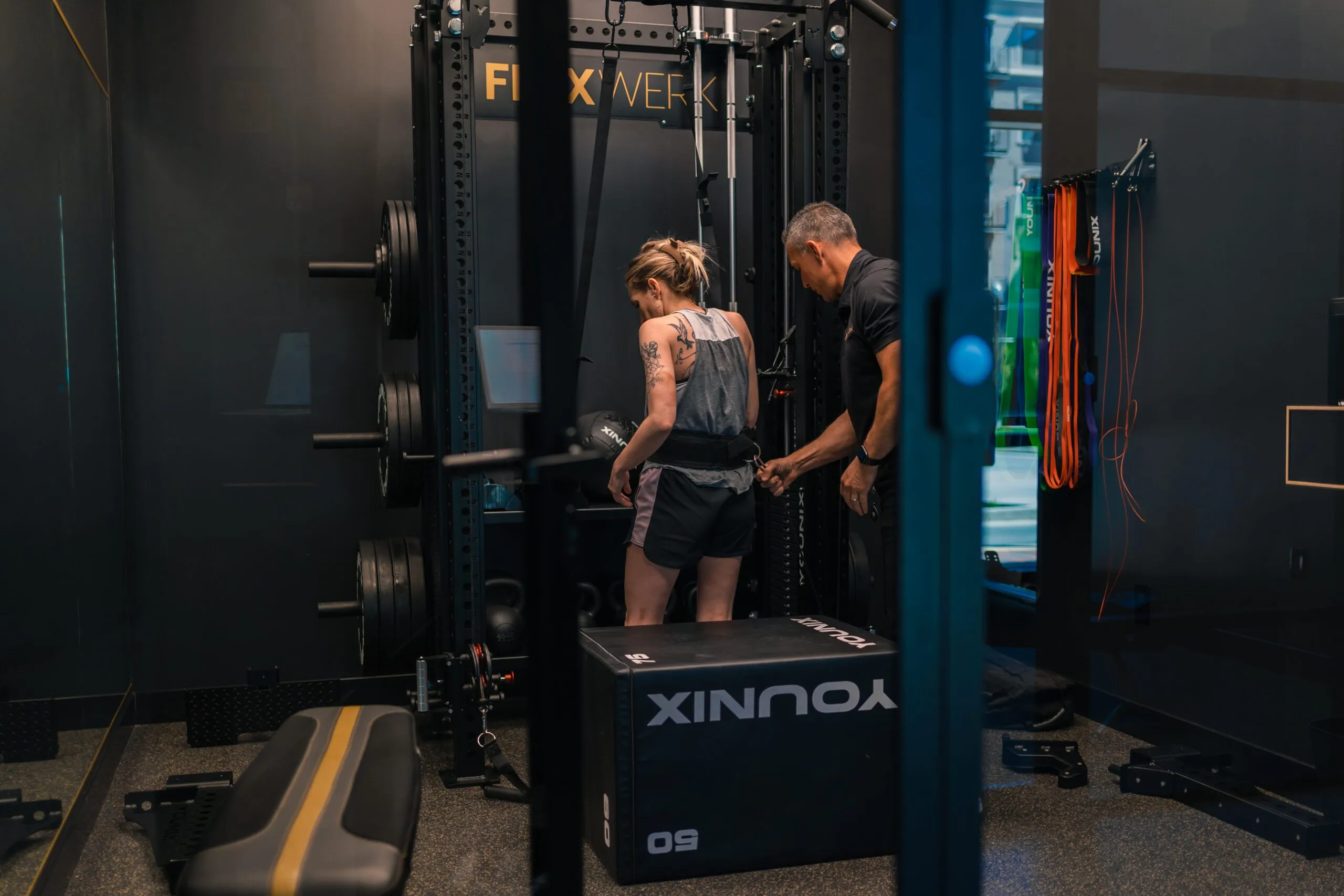
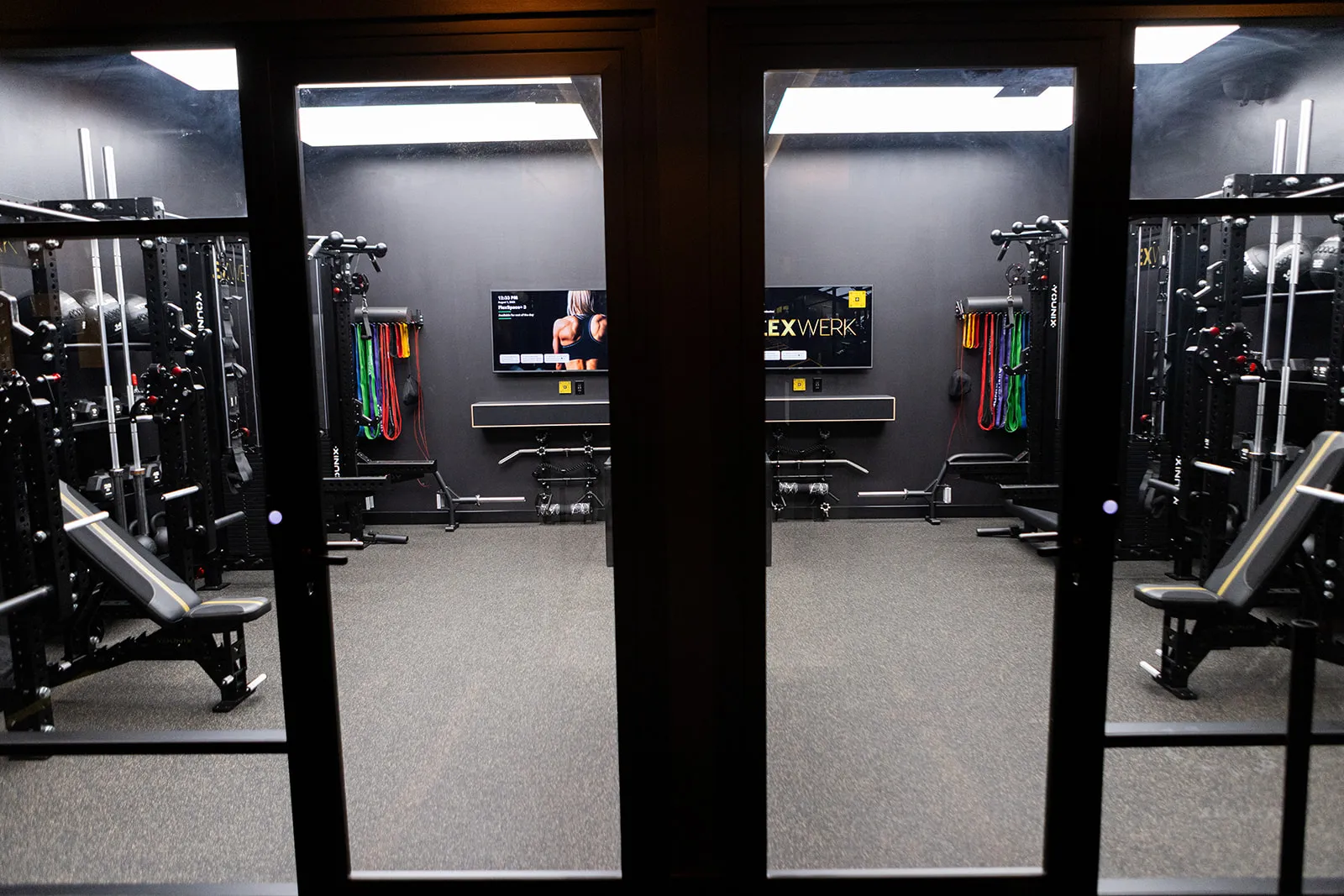
This is why the setting of beginner coaching matters as much as the coaching. At FlexWerk, sessions happen in a FlexSpace — a fully equipped private room (lifting rack, cable system, dumbbells, your own music and lighting) behind a door. Your wobbliest first squats, your questions that feel too basic to ask, your rest breaks — all of it audience-free. There’s a hidden curriculum benefit too: because the room holds one rack, one cable system, and one dumbbell set instead of eighty mystery machines, the equipment stops being overwhelming. You learn a small number of tools deeply, which is exactly how competence — and then confidence — actually forms. There is no gym floor to walk, ever. For beginners, that’s not a luxury feature; it’s the removal of the actual obstacle, and it’s the core of why private training defuses gym anxiety so completely.
Weeks one through twelve: the honest arc
Beginner progress follows a predictable, encouraging script. FlexWerk frames it as a phased 30/60/90 system, and here’s what each stretch feels like from inside:
Reset (roughly the first month). Habits, movement quality, showing up. Strength climbs surprisingly fast — that’s your nervous system learning to use muscle you already have — and daily energy usually improves before anything visible changes. This is also where a coach quietly fixes the sleep-and-eating basics that decide everything downstream.
Build (the middle stretch). Loads increase in small, planned steps — the progressive overload that drives real change. Clothes begin fitting differently; the InBody re-test typically shows muscle up and fat down even when the scale barely moves, which is exactly why the scale isn’t the scoreboard.
Refine (day 90 and beyond). Details, nutrition precision, and the compounding that separates people who trained for three months from people who trained for a year. Beginners never believe they’ll reach this phase; attendance is the entire trick.
When you honestly might not need a trainer
Fair is fair: not every beginner needs coaching. If you’re self-motivated, genuinely comfortable in gyms, and patient enough to learn movements from reputable sources while progressing slowly, you can absolutely start alone — many people have. Coaching earns its cost when any of these is true: you don’t know where to start and the research is becoming the hobby; you’ve “started” several times and stopped; the gym environment repels you; or you have history (injuries, decades off, a body that’s changed) that makes guessing feel risky. One scope note: coaches teach movement and build programs — medical questions, existing conditions, and clearance conversations belong with your physician first.
For most true beginners, the honest math favors a coach for at least the first few months: you’re buying correct habits at the exact moment habits are being formed, in the format best suited to forming them.
The no-risk way to find out
FlexWerk’s on-ramp was built for exactly your situation: a free consultation — private conversation, free InBody baseline, zero obligation — then a free first session with a coach matched to you through FlexConnect (goals, schedule, personality, and yes, “patient with beginners” is a matchable specialty). No membership exists to buy; clients book with their coach and guest access is free — bring a friend to the first session if moral support helps, that’s allowed and common. The location cooperates too: Carmel City Center, steps from the Monon Trail, garage parking a short walk, hours from 5 AM to 9 PM on weekdays and 7 AM to 4 PM on weekends.
Every experienced lifter you’ve ever envied had a day one. Yours can be free, private, and gentler than you’ve been imagining it.
Related questions
Do I need to get in shape before hiring a trainer?
No — that's like cleaning before the housekeeper arrives. Coaches build programs from wherever you actually are; 'complete beginner' is the most common and best-understood starting point there is.
What should I wear to a first session?
Anything you can move in — athletic shoes, comfortable clothes. Nothing technical or new is required; your coach cares about how you move, not what you're wearing.
Will I be wrecked with soreness afterward?
A good coach deliberately under-doses your first sessions, so expect mild next-day soreness, not the can't-sit-down kind. Punishing beginners is bad coaching, and it's how people quit in week one.