
Golf Fitness Training for Westfield Golfers
A faster, more durable golf swing is built in the gym, not bought in the pro shop: rotational power, hip strength, and a back that can handle a full season set the ceiling on every swing change you will ever make. Westfield golfers can build all three one-on-one, about 10 to 15 minutes down US-31 at Carmel City Center; the Westfield personal training page covers the local coaching picture, and this guide covers the golf-specific work.
Why golfers hire a fitness coach at all
Lessons refine the swing you have; they cannot add speed your body does not produce. That is the blunt reason golf fitness exists as a discipline. The driver distance that drifts away through the 40s and 50s is mostly a strength and power story, not a technique story, and no amount of range time reverses it. The other half of the case is durability: an amateur season around Westfield runs from spring thaw to the last warm week of October, and the lower back, lead hip, and shoulders take every swing of it. Golfers who train tend to finish the season they started; golfers who do not tend to manage twinges from July onward.
The mechanics of clubhead speed, what actually produces it and what to train first, get a full breakdown in our golf fitness training guide. The short version: the swing is a ground-up chain, and the gym is where you strengthen its links.
The Indiana calendar is a training calendar
Westfield golf lives inside a hard seasonal window, and smart training uses it instead of fighting it. From November through March the courses sleep, January’s average high sits around 33 degrees, and those are precisely the months when strength and speed get built: two sessions a week with nothing to conflict with them, arriving at the first warm weekend measurably stronger than you finished. The full winter blueprint is in the golf off-season workout guide.
If you keep the swing alive over winter with indoor simulator time, pair the two deliberately: strength early in the week, speed and swing work later, so the body practices expressing its new force where it matters. The winter calendar has one more gift, accountability; a booked Tuesday session in January survives weather that cancels every good intention.
In season the dose flips: one or two shorter maintenance sessions protect the winter’s gains without stealing energy from weekend rounds. Golfers who train year-round on that rhythm compound; golfers who restart each winter from zero stay where they are.
What rotation and durability coaching looks like
An honest golf block starts with an assessment, because the swing exposes whichever link is weakest: hip and mid-back rotation get screened, strength gets baselined, and the program aims at your specific limitations rather than a generic golfer template. From there the work runs on four tracks:
- Rotational mobility, loaded. Hip and thoracic rotation trained through range you can control, so the backswing turn comes from joints rather than from a straining lower back.
- Lower-body and hip strength. Squat, hinge, and single-leg patterns: the ground force that starts every powerful swing.
- Anti-rotation core work. The trunk’s job is transferring force without leaking it, and that is trained directly.
- Speed intent. Medicine-ball throws and fast, light movements that teach the new strength to express itself quickly.
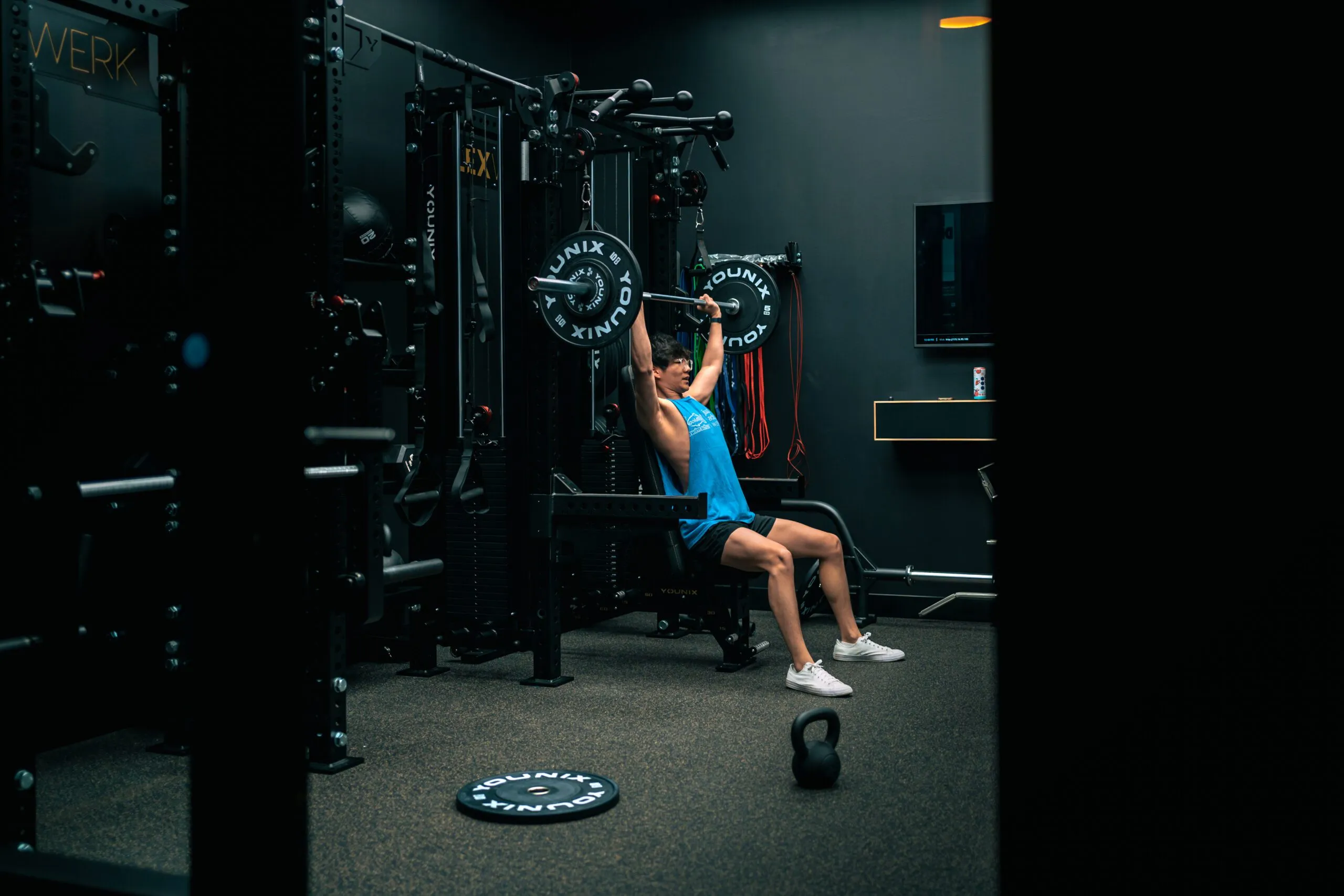
Sessions run in a private FlexSpace with the rack, cables, and dumbbells inside the room, and the setup is deliberately filming-friendly: a coach can capture a movement on the room’s monitor, review it with you on the spot, and fix the pattern in the same set. One golfer, one coach, no gym-floor audience while you rehearse rotations with a club in your hands.
Honest expectations, and one health note
No coach can promise yards, and you should walk away from any who does. What golfers commonly notice first is less glamorous and more valuable: an easier full turn, less next-day back stiffness, and late-round swings that still look like early-round swings. Distance tends to follow force production, on its own schedule. Golfers past 50 chasing speed specifically should read adding driving distance after 50 for the age-adjusted version of the plan.
The health note: if your back already has a history, or any joint has your physician’s attention, that conversation comes before the first session. A good coach trains alongside medical guidance, adapts around cleared issues, and sends anything symptomatic back to the clinic rather than programming through it.
From the first tee in Westfield
The logistics are the easy part: minutes off US-31 at Carmel City Center, 10 to 15 minutes for most Westfield addresses, garage parking a short walk from the door. Hours run 5 AM to 9 PM weekdays and 7 AM to 4 PM weekends, so sessions fit before work, at lunch, or around weekend tee times. FlexConnect matches you with one of more than 40 independent coaches; ask for someone who works with golfers, and bring your goals for next season to the free consultation, which includes a free InBody body composition baseline. Coaches set their own rates by format and goals, so the consultation is also where pricing gets specific to you.
The off-season is the swing change nobody sees until spring, and it starts whenever you decide it does. Book the consultation, get the baseline, and start building the body your swing has been waiting on.
Related questions
Can I really add distance after 50?
Often, yes, because distance loss with age is mostly strength and power loss, and both are trainable at every age. No coach can promise a yardage number, but rebuilding rotational power reliably moves clubhead speed in the right direction.
Should I train during the golf season?
Yes, at a maintenance dose. One or two short sessions a week protect the strength you built over winter; stopping entirely from April to October is how each off-season ends up starting from zero.
Will lifting make my swing feel stiff?
Good golf training does the opposite: it pairs strength work with rotational mobility, so you gain range along with force. Stiffness comes from training that ignores rotation, not from strength itself.