
Mat Pilates vs Reformer: Which Private Session Do You Need?
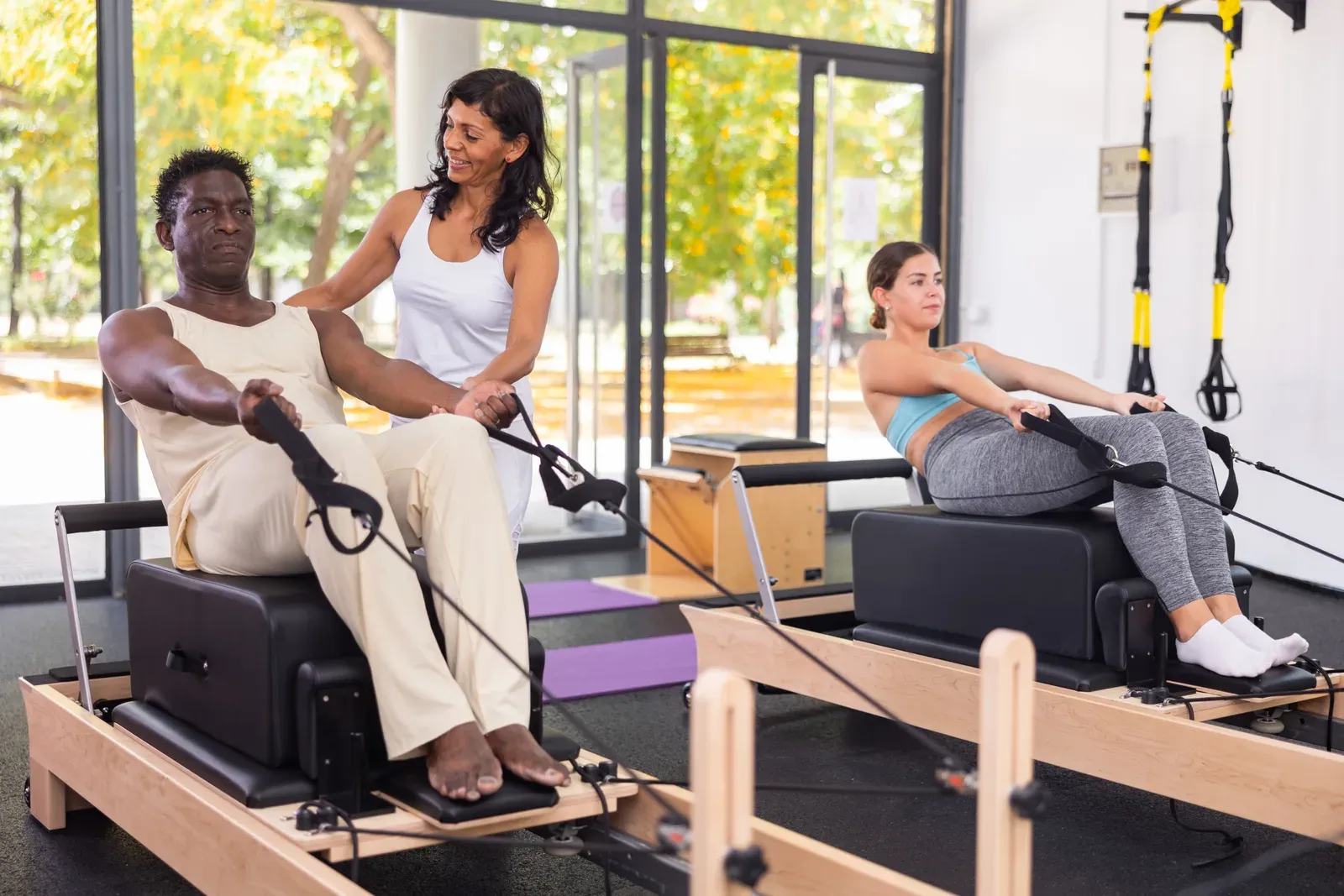
A reformer and a mat teach the same method through opposite tools: the reformer’s springs and sliding carriage add support and adjustable resistance, while mat Pilates removes both and makes your own body the entire apparatus. If you are searching for reformer Pilates in Carmel, that difference decides your answer, because a private training room like a FlexWerk suite fits mat work and small apparatus comfortably and does not hold a reformer. Which of FlexWerk’s independent professionals currently teach mat-based or Pilates-informed sessions is a question for the coach matching conversation; this page is about choosing the format first.
What the reformer actually adds
Support and feedback. The carriage slides on rails against springs, so a beginner can perform a footwork series lying down with the springs doing part of the work, and an advanced student can load the same movement heavier by adding springs. The straps, footbar and box create positions that are nearly impossible to reproduce on the floor. That support is why reformer classes feel accessible on day one and why physical therapists borrow the machine for controlled early loading.
The machine also has costs. It is large, expensive and studio-bound, so reformer work happens on a studio’s schedule and in a studio’s room. And the support that flatters a beginner can hide weakness: the carriage will carry a set your deep core did not.
What mat work demands, and gives back
Everything. With no springs to assist, a roll-up is your own spine articulating against gravity, a hundred is your own trunk holding the position, and a side kick series is your own hip stabilizing on a moving leg. Mat Pilates is commonly regarded as the harder of the two formats to do well, which is precisely why instructors treat it as the truest test of the method. It is also portable: a mat, a ring, a light ball and a resistance band fit in a bag, and instructors working outside a studio typically bring those props themselves.
The small apparatus matters more than its size suggests. A magic circle turns a bridge into an inner thigh exercise, a band adds the pull that mat work otherwise lacks, and a small ball under the sacrum creates instability that a reformer’s rails remove.
A private room fits one of these honestly
| Reformer session | Mat and small apparatus session | |
|---|---|---|
| Where it happens | Dedicated Pilates studio | A studio or any quiet private room |
| Resistance | Adjustable springs | Body weight, bands, ring, ball |
| Beginner support | High | Lower; instruction carries it |
| Progression ceiling | Springs, then technique | Technique, then added load |
| Fits a FlexWerk suite | No | Yes |
A FlexSpace Standard is 150 square feet and a FlexSpace Plus is 200, both with music, a monitor and controllable lighting, which is room enough for two mats and every prop an instructor carries. What the suite adds that neither format has on its own is the rack, cables and dumbbells along the wall, so a mat session can finish with loaded hinges and rows, the progression that pure Pilates eventually runs short of; the reasoning behind that pairing lives in Pilates versus strength training.
How to choose in one conversation
Choose the reformer if the machine is the point for you, if you are a complete beginner who wants the springs’ support in the first months, or if a physical therapist has recommended it for early rehab loading. For all three, a dedicated studio is the right answer and nothing here argues otherwise.
Choose mat and small apparatus in a private room if the outcomes are the point, meaning core control, posture, a calmer hour without a class, and eventually the progressive strength that protects muscle and bone after 40. Anyone managing osteoporosis, a disc history or a recent surgery brings physician guidance into the choice, because spinal flexion, which mat work contains plenty of, is often the movement clinicians ask to modify.
Then ask the only question that settles it: at the free consultation, which includes a free InBody body composition scan, ask which coaches currently offer mat-based or Pilates-informed sessions and describe the hour you want. The longer Carmel discussion of that fork is in the private Pilates guide, and the yoga version of the same private-room question in private yoga instruction in Carmel.
Pick the tool that matches the goal, and the room follows.
Related questions
Is mat Pilates as effective as reformer Pilates?
For core control, posture and body awareness, mat work is at least as demanding and often more so, since nothing assists the movement. The reformer wins for supported early loading and for variety; the mat wins for portability and honesty.
Can a reformer fit in a private training room?
In theory a room could hold one, but FlexWerk's suites are equipped for strength coaching, with a rack, cables and dumbbells, and do not include a reformer. Plan on mat work and small apparatus in a private room, and on a studio for the machine.
Who teaches Pilates at FlexWerk?
That changes, because the coaches are independent professionals who set their own formats. Ask at the free consultation which coaches currently offer mat-based or Pilates-informed sessions rather than assuming from any web page, including this one.