
How Accurate Is Apple Watch VO2 Max?
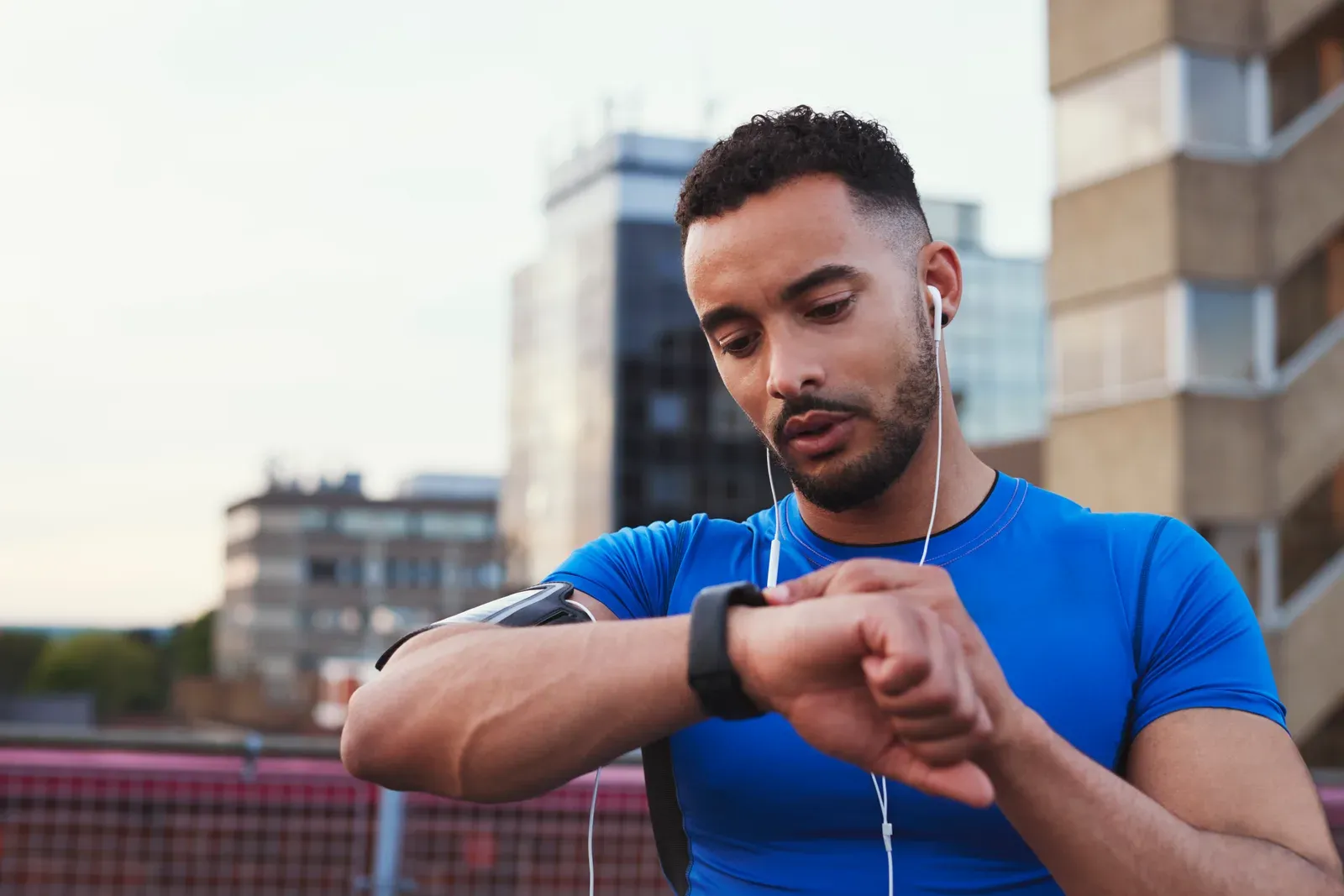
Apple Watch VO2 max is a reasonable estimate, not a measurement: validation research generally finds it lands within about 10 to 15 percent of a true lab test, sometimes closer, sometimes further. That makes the absolute number soft, but the trend over months genuinely useful. The watch is measuring something real about your cardio fitness; it is just measuring it through a keyhole.
How the watch estimates VO2 max
The watch never measures oxygen at all, which is the core limitation. A real VO2 max test happens in a lab with a mask analyzing every breath while you push to true exhaustion. Your watch instead watches the relationship between your heart rate and your pace during outdoor walks and runs, then infers what your maximal oxygen uptake probably is from how efficiently you move at submaximal effort.
That inference works reasonably well when conditions are clean: flat ground, GPS locked, steady effort, good wrist contact. It gets noisy when conditions are not, which explains most of the mysterious jumps people see:
- Hills and wind change the effort-to-pace relationship without changing your fitness.
- Heat raises heart rate at any given pace. Anyone training through an Indiana July, with its long stretches of humid upper-80s and 90s days, has watched their estimate sag for reasons that have nothing to do with fitness.
- Walks pushing a stroller or jogging with a dog distort the pace signal.
- Beta blockers and some other medications blunt heart rate response, which can skew the estimate badly. That is a conversation for your physician, not your watch.
None of this is unique to Apple. Every wrist-based VO2 estimate, whatever the brand, leans on the same style of inference and inherits the same weaknesses.
What the number is actually good for
The estimate earns its keep as a long-term trend and a rough fitness tier, not as a precise score. Used well, it answers two questions. First, which broad band are you in for your age: low, average, above average, or high? The watch is usually right about the band even when it misses the decimal. Second, and more valuable, is your cardio fitness rising or falling across seasons of training? A number that climbs from 34 to 38 over six months of consistent work reflects real adaptation, even if the true values were 36 and 40.
You can also improve the quality of the estimate itself. Keep your height, weight, and medication settings current in the Health app, wear the watch snug, and give it regular outdoor walks or runs on flat ground so the algorithm has clean data to learn from. A steady 30-minute route repeated weekly does more for estimate stability than a dozen chaotic workouts.
That trend matters more than most wrist metrics because VO2 max is one of the strongest single predictors of long-term health and longevity in the research. If your estimate is low for your age, that is worth acting on with structured training rather than worry.
What the number is not good for: comparing yourself to a friend with a different device, panicking over a two-point weekly drop, or standing in for actual performance. If your Saturday long runs on the Monon keep getting faster at the same heart rate while your training partners from the Carmel Runners Club drift behind you, your fitness is improving no matter what the widget says this week.
How a coach reads it alongside better data
A trainer treats watch VO2 max as one input among several, weighted by its reliability. In a coached program, the estimate sits next to numbers that are directly measured: how much you lift, how your pace at a fixed heart rate changes, how quickly your heart rate recovers after hard intervals, and what your body composition is doing. At FlexWerk in Carmel, that last one comes from an InBody scan at the free consultation, because muscle mass and body fat are measured directly rather than inferred, and they change the meaning of every cardio number. A rising VO2 estimate alongside rising muscle mass tells a very different story than the same estimate alongside muscle loss. Each source in that stack checks the others, which is exactly what a single wrist metric can never do for itself, and it is why coached clients tend to stop arguing with their watches.
The practical hierarchy looks like this: trust performance first, body composition second, watch trends third, and any single-day reading last. The same logic applies across the wearable dashboard, from calorie estimates to recovery scores: direction over magnitude, months over days.
The honest bottom line
Your Apple Watch VO2 max is accurate enough to tell you where you roughly stand and whether you are genuinely improving, and not accurate enough to obsess over. If the trend has been flat for a year, that is not a device problem; it is a programming problem, because cardio fitness responds reliably to structured training at almost any age. Two or three properly dosed sessions a week move the number, and how to improve VO2 max over 40 lays out exactly what that training looks like. More importantly, those sessions move what the number represents: your engine for hiking, racing, keeping up with your kids, and aging well.
If you want that trend pointing up by this time next year, start with a free consultation: a baseline, a conversation about your goals, and a plan that treats your watch as a helpful witness instead of the judge.
Related questions
Why did my Apple Watch VO2 max drop when I got fitter?
Usually because the conditions of your outdoor walks or runs changed: heat, hills, headwinds, or a different route can skew the estimate. Judge the trend over months, not week-to-week wobbles.
Do I need a lab test to know my real VO2 max?
Only if you need the exact number, which most people do not. For general training, the watch trend plus performance markers like pace at a given heart rate tells you plenty.
Is a low estimated VO2 max dangerous?
It is a flag, not a diagnosis. Low cardiorespiratory fitness is strongly linked to long-term health risk, so treat a low estimate as a reason to train and, if you have health concerns, to talk with your physician.