
One Coach, Two Programs
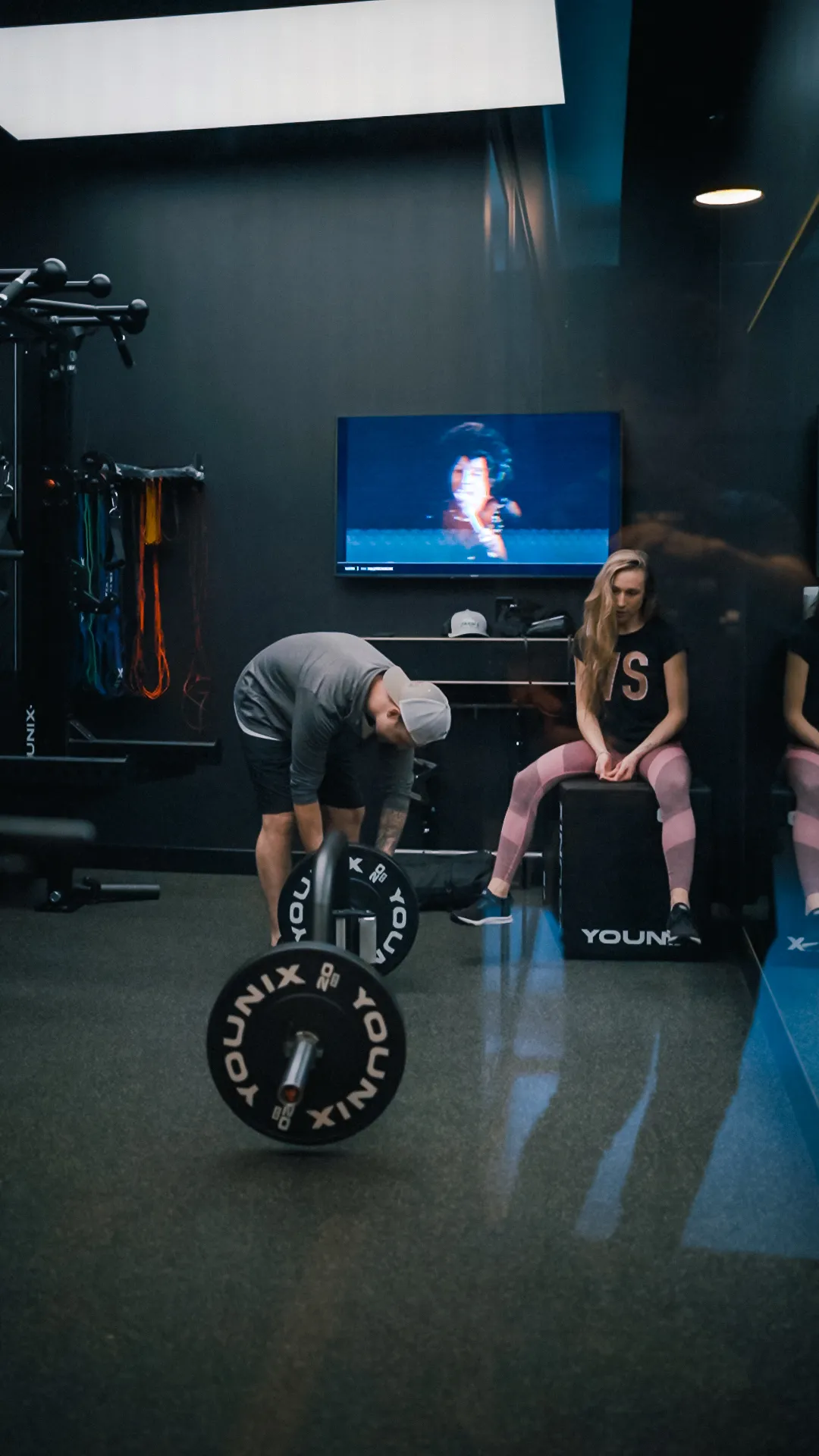
You are not doing the same workout. You share a coach who runs two programs in parallel: one of you at the rack while the other works the cables, loads prescribed individually.
Carmel City Center · Serving the north side
The most reliable training partner you will ever have already lives with you. One private suite, one coach, two individual programs, and an appointment neither of you wants to be the one to cancel.
Complimentary wellness assessment · No commitment required
Partner training in a private suite
You are not doing the same workout. You share a coach who runs two programs in parallel: one of you at the rack while the other works the cables, loads prescribed individually.
A solo gym plan negotiates with one tired person. A couples session has to defeat two people, a booked coach, and a reserved room at the same time. It rarely loses.
Whichever of you is newer to training gets to be exactly that, without strangers as witnesses. Your music, your lighting, and an hour that is genuinely yours.
How couples coaching works
The habits that survive are the ones with witnesses, and canceling on your spouse and your coach in the same text is more than most people can manage. That structural stubbornness, covered more broadly inaccountability as the real product, is the quiet engine of couples training. There is a second effect solo trainees do not get: the shared vocabulary. When both of you know what a hinge is, why protein matters, and what Tuesday's session cost, healthy eating and early nights stop being one partner's project and become the household's operating system. The gains leak out of the gym and into the kitchen, which is where most results are actually decided.
The near-universal hesitation, "one of us is much fitter," misunderstands how coached sessions work. In a FlexWerk suite, one of you squats from the rack while the other works a cable row, loads and progressions individually prescribed, the coach circulating between sets. The Standard suite comfortably hosts a pair, and the larger FlexSpace Plus, 200 square feet with equipment supporting 1,100+ exercises and room for up to 4 guests, gives a couple all the space two simultaneous programs need. The compatibility that actually matters is not fitness level but goals that can coexist in one hour, and strength for one plus conditioning-heavy fat loss for the other co-programs easily. The honest cost-and-logistics answer lives incan spouses share training sessions.
On a gym floor, couples training has an audience. In a private suite, it has a door. For parents especially, it is often the one hour of the week that is just the two of you and a shared project: an odd, sweaty, surprisingly effective date. The private cardio suites, with HYDROW rowers, CLMBR climbers, and curved treadmills, give coaches a side-by-side option for shared warm-ups and finishers. Hours leave room for the two windows couples actually have, before the kids wake or Saturday morning, and there is no membership for either of you: the coach's booking covers the suite, and guest access is free for clients.
Progress gets measured individually even though the session is shared. Each of you starts with your own InBody body-composition baseline from the free consultation, each follows the 30/60/90 system, Reset, Build, Refine, at your own pace, and each re-tests on your own numbers. That matters in a couple, where one body often responds faster than the other: separate scoreboards keep the faster responder honest and the slower one encouraged, instead of letting one shared metric quietly discourage half the partnership.
Skip the shared session if your goals genuinely conflict, if one of you wants training to be away time, which is a legitimate preference worth saying out loud, or if the dynamic turns competitive in a way that pushes one partner past sensible loads. Coaches see all three regularly, and the fix is simple: separate sessions, same facility, coordinated calendars. Some couples run a hybrid of one shared session plus one solo each, whichsemi-private formatshandle naturally. And the scope note that applies to every page like this: if either of you has medical conditions in play, that conversation happens with your physician first, and your coach programs inside the guidance.
Starting together, free
Book the free consultation together: one conversation about both sets of goals, a free InBody body-composition scan for each of you, and a FlexConnect match to a coach whose specialties fit the pair of you. The first session is free, so you can train an actual hour and compare notes on the drive home before spending anything.

At Carmel City Center, serving the north side
FlexWerk is at 885 Monon Green Blvd, Suite 120, Carmel, Indiana 46032. Steps from the Monon Trail, with garage parking a short walk away. From Carmel City Center we serve the whole north side: seepersonal training in Carmel, plus our pages forFishers,Zionsville, andNoblesville.
Guest stories
Before you book together
No. This is the most common worry and the most solved problem in couples coaching. You share the room and the coach while each following your own loads and progressions.
Commonly yes on a per-person basis, since you are sharing one coach's hour. Rates are set by each independent coach, so the free consultation is where you get real numbers for your situation.
The other keeps the appointment. Coaches adjust programming around each person's schedule, and the standing session surviving one partner's travel is part of why couples' consistency holds.
Neither of you does. There is no membership at FlexWerk: your coach's booking covers the private suite, and guest access is free for clients.
No commitment required
Tell us about both sets of goals and a host will match you with the right coach, or skip the form and call(888) 353-9975.
A few quick questions so we can match the two of you to the right coach and plan.
Leave your details and a FlexWerk host will call you.
No commitment required
Book your free consultation, get your complimentary wellness assessment, and feel the difference of a private FlexSpace for yourself.
Welcome!
Meet Rex, your 24/7 AI assistant. He's here to help you explore how FlexWerk Fitness can support your needs and answer any questions you have. Choose how you'd like to connect:
Call or Talk Live with Rex, Our AI Voice Guide
Want a real conversation over the phone +1 888 316-6530 or online? Rex can speak with you directly through your browser. No downloads..., no wait times. Ask about FlexWerk Fitness, our private training spaces, co-working options for fitness professionals, or how we can support your goals. Rex is ready for a one-on-one conversation with you right now. Read more..
Chat Instantly with Rex, Your AI Assistant
Prefer texting? Rex is your instant guide for answers, information, and a walkthrough of what FlexWerk Fitness offers.... Ask about private training spaces, memberships, availability, or how to get started. Rex will respond in real time to help you find the right fit. Read more..