
How to Build Glutes for Women: The Lifts That Matter
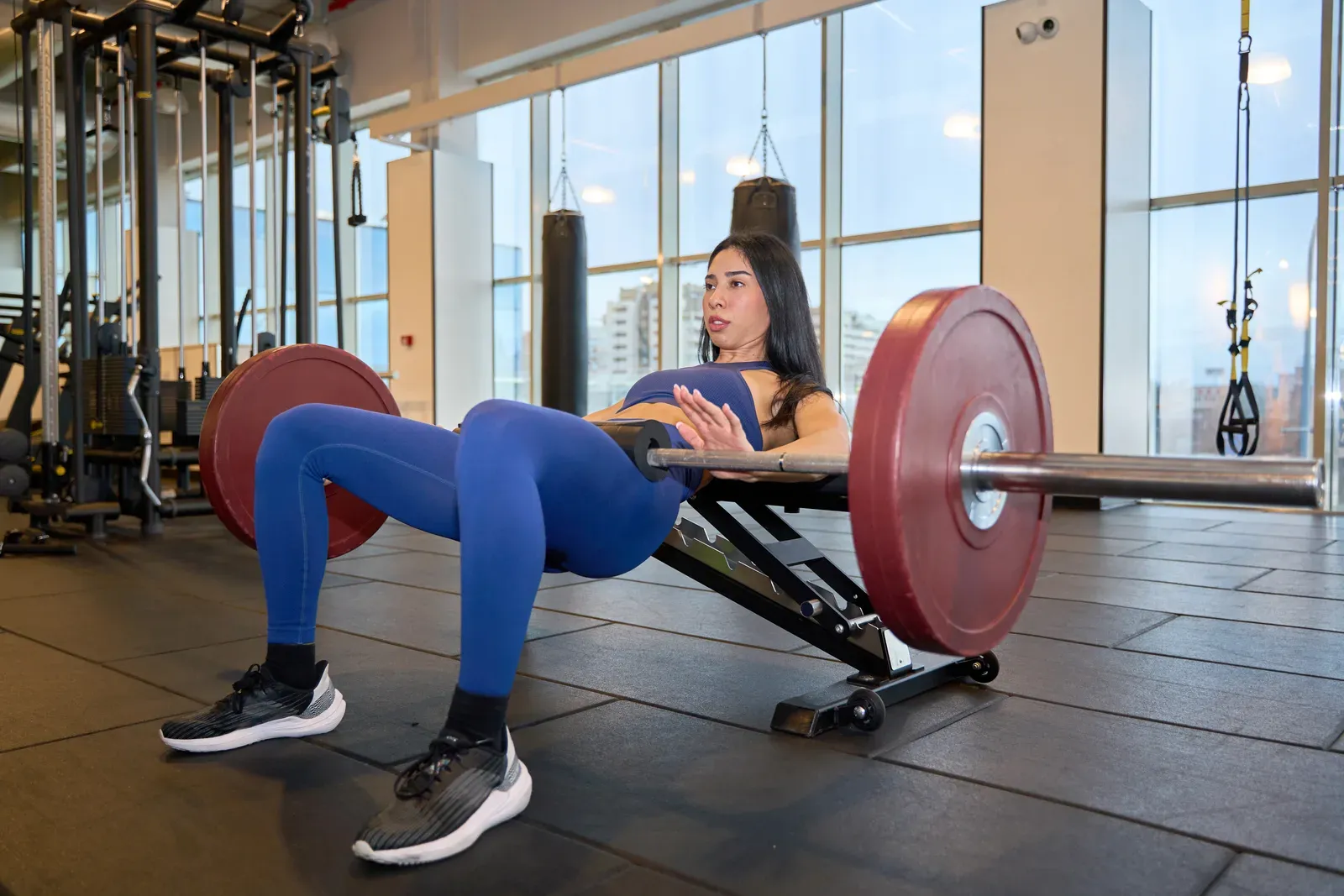
To build glutes as a woman, train three movement families that load the hips directly, a hip thrust, a split squat and a hip hinge, two or three times a week, and add small amounts of weight or reps every one to two weeks. Shape follows strength here. Most beginners who stay consistent can expect the first visible change in the eight to twelve week range, with the lifts getting easier well before the mirror agrees. A coach who works with women can set the loads so each session is challenging without being guesswork.
The three lifts that carry the plan
Glute training gets confusing because there are hundreds of exercises. You need only three patterns, and everything else is a variation.
The hip thrust is the most direct way to load the glutes at the top of the movement, where they work hardest. Your upper back rests on a bench, your feet are planted, and you drive your hips up until your torso is level with the floor. Start with a dumbbell across your hips or a cable, and move to a barbell when the weight justifies it.
The split squat puts one leg in front and one behind, and you lower straight down. It teaches balance, trains the glute of the front leg through a long range, and is kinder to the lower back than a heavy back squat. Hold a dumbbell in each hand once your body weight feels easy.
The hip hinge, usually a Romanian deadlift, loads the glutes and hamstrings as you push your hips back with a flat spine and nearly straight knees. Think of closing a car door with your backside. It is the lift most people learn wrong first, so it earns a form check.
A 12 week progression you can follow
Treat the weeks as three four-week blocks, and change only one thing per block.
- Weeks 1 to 4, learn the patterns. Two sessions a week. Three sets of 10 to 12 reps on each lift, with weights that leave two or three reps in reserve. The goal is clean movement, not exhaustion.
- Weeks 5 to 8, add load. Two or three sessions. Keep the sets, raise the weight when you hit the top of the rep range on every set, and note what you lifted so you have something to beat.
- Weeks 9 to 12, add volume or difficulty. Move to a barbell thrust, a rear-foot-elevated split squat, or a fourth set. This is where most women notice jeans fitting differently.
If a session goes badly, repeat the weights next time rather than forcing a jump. A week of the same load is not a failed week.
What changes, and when
Strength changes first. Within a few weeks, the weights you started with usually feel light because your nervous system gets better at recruiting muscle. Measurable size takes longer. A reasonable expectation for a beginner is that the shape begins to look rounder and firmer in roughly two to three months, and keeps changing for a year or more if the loads keep rising.
Two things stall the process more than anything else. The first is training too lightly for too long, since muscle grows in response to a demand it has not met before. The second is eating too little, because building tissue needs fuel. Most adults do well aiming for a protein-forward plate at each meal and a calorie level that is not an aggressive cut. If fat loss is also a goal, a modest deficit is the workable zone, which is the same logic described in the body recomposition guide.
Why band kicks and “burn” are not the plan
Light, high-rep work with a small band has a place as a warm-up, because it wakes up the muscle before heavy sets. As the main course it is a poor fit. The burning sensation comes from fatigue and metabolic byproducts, not from the mechanical load that signals growth. If a set of fifty reps feels easy to stop at, you could have used a heavier weight for fifteen.
The fear that lifting will make a woman bulky is also worth settling directly. Visible size takes sustained, deliberate programming and years of effort, as the bulky question explains. For most women the realistic outcome of progressive glute training is a stronger, firmer lower body.
Common stall points and how to fix them
- You feel it in your lower back. Your ribs are flaring on the hip thrust. Tuck your chin, keep your ribs down and stop the lift when your hips are level with your torso, not higher.
- You feel it in your quads. Move your feet slightly farther from the bench, and pause for a second at the top.
- The weight stopped going up. Check sleep and protein first, then try adding a rep per set rather than five pounds.
- Your knees complain on split squats. Shorten the stride and keep your front shin more vertical, or switch temporarily to a step-up onto a low box.
A sample week
If three lifts feel like a lot to schedule, here is a layout that fits most calendars. Day one covers the hip thrust first, then a split squat, then a row for balance. Day two, at least a day later, leads with the Romanian deadlift, followed by a step-up or leg press and a few sets of back extensions or a cable pull-through. A third, lighter day can repeat the thrust with a pause at the top and finish with walking or easy cycling. Keep every session under about an hour so the quality of the heavy sets stays high.
Where to do the work
A hip thrust needs a stable bench, room to unload a barbell and a space where you are not worried about who is watching. At FlexWerk in Carmel, training happens in a private suite with a custom lifting rack, a cable system and a full set of dumbbells, which suits the three lifts above. If you want to see where you are starting from, the free consultation includes a free InBody body-composition scan, and the beginner-focused weight training guide for women covers the first month in more detail.
Pick one day this week for a hinge, a thrust and a split squat, write down the weights, and plan to beat them in two weeks.
Related questions
How many days a week should I train glutes?
Two to three sessions a week suits most beginners and returning lifters. Spreading the work across days beats one marathon session, because each lift is done fresh and you recover between them.
Why do I feel squats in my quads and not my glutes?
Squat depth, foot position and where your weight sits all shift the load. A coach can watch one set and change stance, tempo or exercise choice so the glutes do more of the work.
Do I need a barbell for hip thrusts?
No. A dumbbell or a cable can load the movement well at the start, and a barbell becomes useful once the weight outgrows what you can comfortably hold or set up.