
Boxing Conditioning Trainer in Carmel: The Workout Without the Fight Gym
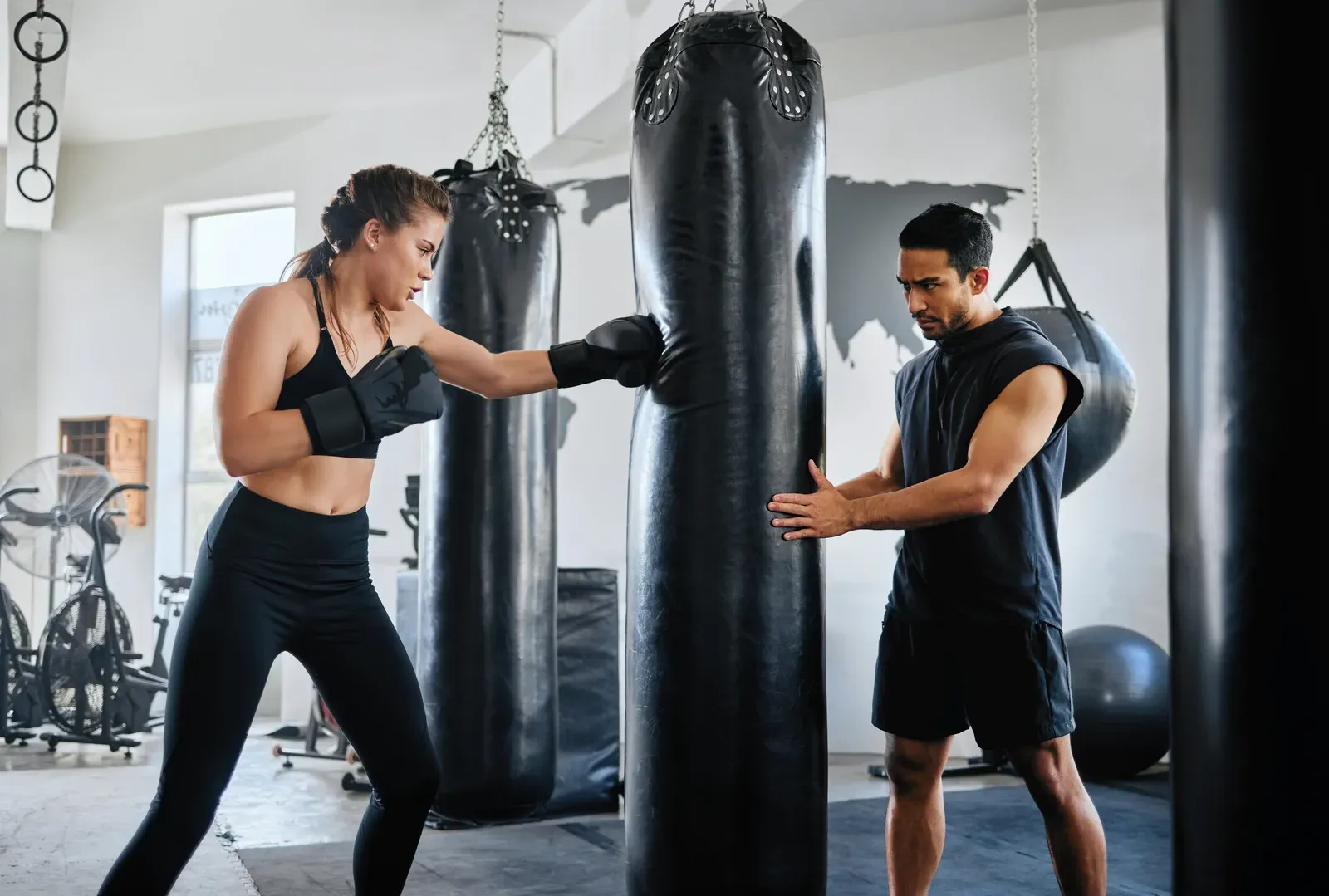
You do not need to join a fight gym to train like a fighter. A boxing conditioning trainer gives you the rounds-based intensity, footwork, and full-body rotational power of a boxing workout, one on one, with zero contact, and in Carmel you can do it inside a fully private room instead of on a crowded floor. The appeal is simple: boxing-style training is one of the most engaging conditioning formats ever devised, and engagement is what keeps people showing up in March. The way in is a free consultation at Carmel City Center, which includes a free body composition scan.
Why boxing-style conditioning works so well
Boxing training earned its reputation honestly. The rounds structure, hard work in two-to-three-minute blocks with short rests, is interval training in its most natural form, and it scales from beginner to punishing by adjusting pace rather than format. The movement itself is full-body in a way few formats match: legs drive, hips rotate, the trunk transfers force, and the shoulders deliver it, hundreds of times an hour.
Then there is the part no treadmill offers: your brain is fully occupied. Combinations, footwork patterns, and rhythm demand enough attention that the clock disappears, which is why people who are bored by cardio machines routinely fall for this format. And the stress relief of hitting-style effort at full intent, even shadowboxing, is real enough that most clients name it as the reason they stopped skipping workouts.
It also slots cleanly into a bigger program rather than replacing one. A common weekly shape is two strength sessions plus one boxing-conditioning session: the strength work builds the engine, the rounds spend it, and neither interferes with the other when a single coach programs both. For busy professionals who can only promise three hours a week, that split covers a remarkable amount of ground.
What a one-on-one session looks like
A private boxing-conditioning session at FlexWerk is built from coached rounds, and a representative hour runs like this:
- Footwork and mechanics warm-up. Stance, guard, and movement patterns, taught patiently because clean mechanics are what make the workout safe and the intensity earnable.
- Shadowboxing rounds. Combinations called by your coach, pace rising round by round. Harder than it looks, and it looks hard.
- Rotational power work. Cable rotations, medicine-ball-style throwing patterns, and explosive pressing, the strength side of a punch, trained on the room’s cable system and dumbbells.
- Machine sprint rounds. Rower or curved treadmill intervals standing in for roadwork, structured in the same rounds rhythm; the private cardio rooms are built for exactly this kind of block.
- A core finisher. Because everything in this format runs through the trunk.
Exact tools vary with the coach you match with, and that is the honest fine print: this is boxing-style conditioning built from footwork, shadowboxing, and loaded power work, not a fight gym with bags and a ring. If hitting a heavy bag or eventually sparring is non-negotiable for you, join a real boxing gym and enjoy it; that is the right room for that goal. For the workout, the conditioning, and the engagement, a private coached room delivers the substance without the commute to fight culture, and pairs it with real strength programming, the combination covered in the hybrid strength-and-cardio guide.
Why the private room matters for this format specifically
Learning combinations is awkward at first. Everyone’s early shadowboxing looks tentative, and on a public floor that is exactly why most adults never try it. At FlexWerk the entire session happens behind a closed door in a reserved private room, one on one, with your own music driving the rounds. Nobody watches you learn. Six weeks later, when the combinations snap, that privacy will have been the reason you lasted long enough to get there.
The one-on-one format also fixes the problem group boxing-fitness classes cannot: pace. A class throws the same rounds at everyone; a coach calibrates rounds to your actual recovery, pushes when your form holds, and stops the round when it degrades, which is where both safety and progress live. Your coach is matched through FlexConnect from more than 40 independent professionals at FlexWerk, so you can ask specifically for conditioning-focused coaching with boxing-style programming. One health note: rounds-based training is genuinely high-intensity, so if you have heart, blood pressure, or joint conditions, get your physician’s clearance before you start, and let your coach build up from there.
The Carmel logistics
FlexWerk sits at 885 Monon Green Blvd in Carmel City Center, steps from the Monon Trail, with garage parking a short walk from the door. Hours run 5 AM to 9 PM on weekdays and 7 AM to 4 PM on weekends, which suits this format’s natural constituencies: the 6 AM crowd who want to start the workday already victorious, and the after-work crowd off the Meridian corridor burning the day down in rounds. In summer, coaches sometimes send roadwork-style intervals out along the Monon Trail and keep the skill and power work inside; in an Indiana January, with highs around 33 degrees, the whole program lives comfortably behind your own door.
The consultation itself is free, includes the body composition scan that becomes your conditioning baseline, and obligates you to nothing; your first coached session is free as well, so the whole experiment costs one visit.
Start the way every good boxing story starts, with round one: book the free consultation, meet a coach who can teach you the rhythm, and find out how fast an hour goes when you are too busy moving to watch the clock.
Related questions
Do I need boxing experience to start?
None. Boxing-style conditioning borrows the workout structure, not the sport. A coach teaches basic stance, footwork, and punch mechanics from zero, and the intensity scales to your current fitness.
Will I get hit?
No. This is conditioning, not combat. There is no sparring and no contact, which is exactly why it suits people who want the workout without the fight.
Is boxing-style training safe for my shoulders and back?
Generally yes when coached and progressed sensibly, and the rotational strength work built alongside it is protective. If you have existing shoulder, back, or heart conditions, clear high-intensity training with your physician first.