
Are There Private Gyms in Carmel, Indiana?
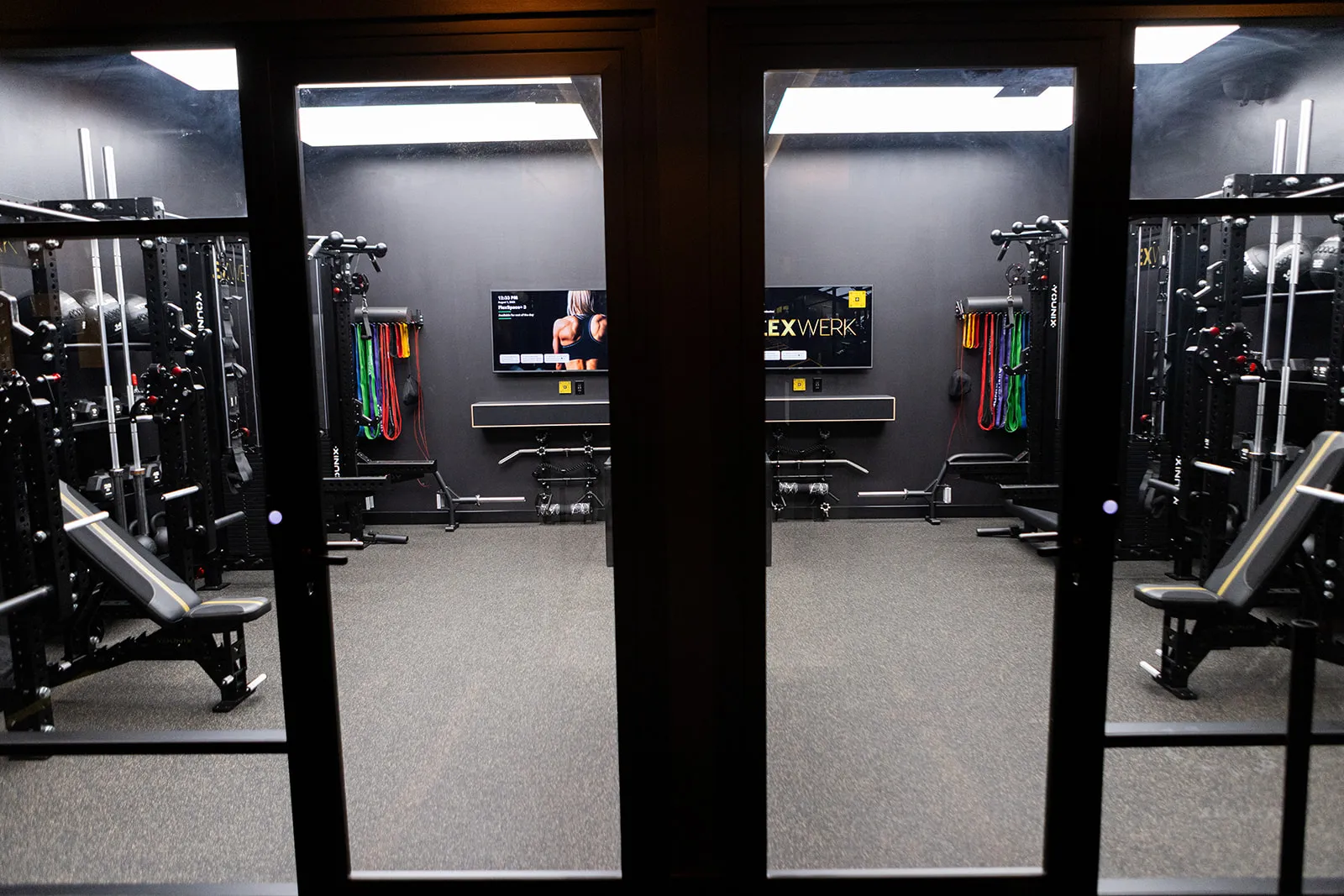
Yes, Carmel has genuinely private training options, and FlexWerk at Carmel City Center is the most literal version of the idea: individual training suites that you and your coach have entirely to yourselves, door closed. But “private gym” means at least four different things in this market, and knowing which one you’re actually shopping for saves a lot of wasted tours.
What “private” actually means (a spectrum)
When Carmel facilities say “private,” they usually mean one of these:
- Boutique studios, small facilities with classes or semi-private sessions. More intimate than a big-box, but you’re still sharing the room with other members and their workouts.
- Semi-private training, one coach working with two to four clients at once in a shared space. Personal attention at a lower price, privacy not really included.
- In-home training, a trainer comes to you. Maximum privacy, but sessions are capped by whatever equipment fits in your garage.
- True private suites, an individual, fully equipped room reserved for your session alone. You, your coach, nobody else, with commercial-grade equipment in the room.
All four are legitimate; they’re just different products. The reason the distinction matters is that they solve different problems: boutique and semi-private options solve the scale problem of big-box gyms, in-home solves the logistics problem, and only the true private room solves the audience problem, training with nobody else in sight. If being watched is the thing that’s kept you from starting or staying, three of the four options don’t actually address it.
The rest of this page focuses on the last category, because it’s the one people usually mean when they search for a private gym, and the one Carmel is least familiar with, since it’s a newer model.
The fully private version: what a suite looks like
FlexWerk’s suites, called FlexSpaces, are individual training rooms behind glass doors at Carmel City Center, a few steps from the Monon Trail. A FlexSpace Standard runs 150 square feet for one or two guests, built around a custom lifting rack, a cable system, and dumbbells that together support 850+ exercises. The FlexSpace Plus is 200 square feet, hosts up to four people, and supports 1,100+ exercises, the couples-and-small-group room. Dedicated cardio suites carry HYDROW rowers, CLMBR machines, and curved treadmills.
Every suite includes WiFi, music streaming, a TV/monitor, and controllable lighting, your session runs on your playlist and your settings, not a house mix. (Full equipment rundown here.) The practical difference is bigger than it sounds: no waiting for a rack, no working in, no audience, and a coach whose attention never has to compete with a crowded floor.
The access model is as unusual as the rooms. There are no memberships, suites rent by the hour, and if you’re training with one of the 40+ independent coaches based there, you receive free guest access as their client. Coaches are matched to you through FlexConnect based on goals, schedule, and personality, and the facility runs 5 AM-9 PM on weekdays and 7 AM-4 PM on weekends, so early-bird and after-work sessions both fit.
Honest fits: when the other options win
Privacy is not automatically the right buy. A big-box membership wins if you mainly want cheap, unlimited solo access to lots of equipment and don’t mind the environment. If it’s the solo access you want without the environment, you can also rent a private workout space by the hour, no membership required. Boutique classes win if group energy is what gets you through a workout, some people genuinely train harder in a pack. Semi-private wins if budget is the deciding factor and you’re comfortable sharing the coach’s attention.
Where the private suite earns its premium is a specific and common profile: you want real coaching, you value your hour too much to spend part of it waiting, and, most common of all, you’d simply rather not train in front of strangers. That last one is quietly the biggest churn driver in fitness; removing it is the difference between a program you follow and a membership you pay for and avoid. The private-suite model exists for exactly that person.
What private training costs in Carmel
Rough market context: big-box and community-tier personal training in the Carmel area typically runs $40 to 70 per hour, while premium and private-tier coaching commonly lands around $75 to 125+ per hour. Fully private settings sit in that upper tier, you’re paying for the coach’s undivided attention and a dedicated room.
Two notes keep that honest. First, rates at FlexWerk are set by each independent coach, so the real answer to “what does it cost” comes from a conversation, not a menu, the free consultation is where that happens, and it includes an InBody body-composition scan whether or not you continue. Second, the price-per-hour comparison undercounts the private option’s value if crowded gyms are why you’ve quit before: the cheapest training is the kind you actually keep doing, and an abandoned membership is the most expensive fitness product ever sold.
How to see one for yourself
The suite model is easier to understand from inside the room than from any description, most people get it within the first five minutes of a session. FlexWerk’s free consultation is a conversation and a baseline scan at Carmel City Center with no membership and no obligation attached; if you’d rather just look at the rooms and equipment first, the spaces page is the next best thing to a walkthrough.
Related questions
Is private training only for advanced lifters?
The opposite is closer to true, beginners often benefit most, because the number-one reason new gym-goers quit is feeling watched, and a private suite removes that entirely.
Can two people share a private suite?
Yes. A FlexSpace Standard is sized for one or two guests, and the larger FlexSpace Plus takes up to four, which is how couples and small-group sessions run.
Do I need a membership to train at a private facility?
At FlexWerk, no, suites rent by the hour and clients of trainers receive free guest access, so there's no membership to buy on top of your coaching.